The Blog / World News

Syria strikes fail to alter Assad’s calculus on chemical weapons, reveals risk-averse US administration

This section is an extract from Le Beck’s Weekly Security Brief that provides insights on more strategic issues.

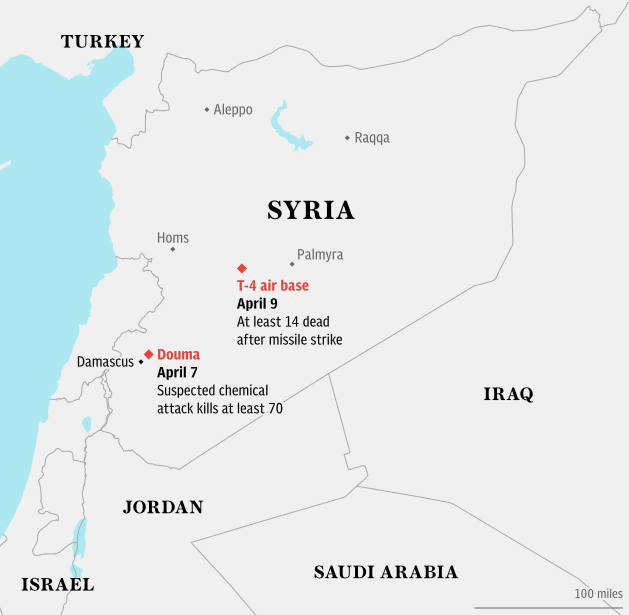
Following a week of tension and speculation in the wake of US President Donald Trump’s threat to retaliate against the use of chemical weapons against the opposition enclave of Ghouta, multiple strikes were carried out by assets belonging to the US, France, and the UK. The strikes targeted three main sites, including the Barzah research centre in Damascus and two storage facilities west of Homs. Further reports indicating that additional facilities were targeted have not been confirmed by any official sources.

While Russia claimed that the Syrian regime’s air defence was able to shoot down most of the missiles fired, the Pentagon, as well as the French Ministry of Defence, both denied this. Satellite images of the Barzah Research Centre also show that the targeted area was completely destroyed.

Of the various responses likely presented to Trump and his French and British counterparts, the one picked by the tripartite coalition certainly wasn’t one of the most extensive ones. Both the number and nature of the targets were limited, with the strikes focusing exclusively on Syria’s chemical program rather than on any of the vectors used to deliver such weapons.

Concerns over the possibility that the strikes could aim to disable or damage the Syrian Arab Air Force (SAAF) prompted efforts by the regime to move its main assets within Russian/Russian-protected air bases, yet this did not materalise. It is likely that, while Russia stood out of the way of the strikes, it did waive the threat of a response or more significant efforts to protect Syrian assets should the West decide to target Assad’s air force. Yet, in light of the precedent of the strike against the Shayrat air base last year, such threats aren’t enough to rule out strikes against the Syrian air force and air bases.

This sends the broader message that the US and its allies do not seek to impact the civil war. The US is, rather, focusing on a narrower approach that also limits the risk of an escalation both with Russia and Iran despite Trump’s initial tweet warning both countries.

This is an important conclusion to draw from the strike, particularly as it relates to the decision-making of the US administration with the arrival of John Bolton who, along with Trump, favoured a broader strike, while Secretary of Defence Jim Mattis sought to avoid an escalation. The fact that Mattis was able to prevail in spite of Bolton and Trump does highlight the fact that the recent changes within the administration may not drastically change the course of US foreign policy, although it also may be too early to draw that conclusion.

Regardless, even within the framework of a narrower effort to only specifically target the chemical program, the strikes were limited. To be sure, they did result in extensive damage to the targeted facilities, particularly the Barzah Research Centre, sending the message that the three countries do have the capability to put key facilities used by the regime out of order for good. Yet, the limited number of targets, the absence of several other relevant facilities, and and the significant delay between the threat to strike and the strikes themselves likely resulted in only limited damage to Assad’s chemical stockpile.

What’s more, despite the cost now clearly associated with the use of chemical weapons, this is still lower than the likely losses Assad and his allies would have suffered in Douma had the main opposition group there, Jaish al-Islam, continued to refuse to surrender. Despite years of siege, the group still had thousands of fighters, tanks, and even anti-aircraft weaponry that would have made even a limited offensive aimed at breaking Jaish al-Islam’s will costly for the regime, which is shorter in manpower than it is in chemical facilities. While Assad initially feared that Trump would order an immediate and extensive strike instead of a response similar to the one in Shayrat, such concerns were unfounded and the use of chemical weapons can still be considered “worth it” for the regime. The fact that they announced the “liberation” of Ghouta the day after the strikes was certainly meant to highlight that thought.

In the wake of the strikes, little will change in terms of the dynamic of the Syrian civil war. Assad’s forces, along with other pro-regime militias fighting, will likely be deployed to conduct offensives against two small opposition pockets, namely, the Rastan pocket and the opposition enclave in the Qalamoun, before potentially turning their eyes towards larger opposition-held territories in northwestern and southern Syria. During these battles, Assad or his commanders on the ground will still consider using chemical weapons if the cost of such use is still assessed to be inferior to the potential losses expected from a conventional offensive.

Iran and Russia are also liable to be unphased by the strikes. If anything, and as noted above, the decision-making behind the response highlights the fact that, despite the recent appointment of Iran hawks, the Pentagon’s position that the US is in Syria to fight Islamic State (IS) still prevails. Tehran and Moscow, who both favour a US withdrawal, can further count on Trump’s own isolationist reflexes and view of the Middle East as a “troubled place” from which the US should exit as quickly as possible.

In that context, a direct response to these strikes would be a mistake, despite explicit Iranian threats, as it could force Washington and its allies back into the conflict, something neither Tehran nor Russia want. Pro-Iranian militias will, however, likely continue to try and undermine the US presence in northeastern Syria, either by pushing into remaining IS territory on the northern bank of the Euphrates, or by staging indirect attacks against the US and its allies through proxies. While such a response may be accelerated by the strikes, it would likely have happened regardless, and it is unlikely that Tehran will take any harsher measures unless the US does actually implement a more proactive anti-Iran policy.

Le Beck talks to the Daily Beast about Trump and Syria

“There’s a lot of confusion in Israel about Trump’s stance,” says Michael Horowitz,  a senior analyst specializing in Israel and Syria at Bahrain’s Le Beck International. “The Israelis are puzzled by the American strategy in Syria and concerned there’s no real commitment to roll back Iranian influence in Syria.”

Read the full article here  

Le Beck talks to The Telegraph about Trump’s threats against Syria

Analysts believe the lull in the bombing is a result of Assad’s forces rushing to move their aircraft to Russian bases in Syria, which are less likely to be targeted by American missiles.

“Since Trump tweeted its initial threats the regime has completely changed its military deployments, particularly its air force, which in turn disrupted its air campaign,” said Michael Horowitz, a senior analyst at the Le Beck geopolitical consultancy.

“In a way, the mere threat of action has already been enough to save lives on the ground,” he added.

Read the full article here  

Sydney Morning Herald talks to Le Beck about Western strikes in Syria

Michael Horowitz, a senior analyst at the Le Beck geopolitical consultancy, said that the regime would probably move its most sensitive equipment close to Russian forces, in the hope that the US would be less likely to risk accidentally striking Russian troops.

Le Beck talks to The Telegraph about Trump, Russia, and Syria

Michael Horowitz, a senior analyst at the Le Beck geopolitical consultancy, said that the regime would probably move its most sensitive equipment close to Russian forces, in the hope that the US would be less likely to hit it and risk accidentally striking Russian troops.

“The Syrian military has already had time to take some contingency measures and evacuate some of the potential targets Washington could decide to strike, which could limit the impact of any possible American intervention,” he said.

“The Syrian air force in particular will likely redeploy to Russian or Russian-protected air base, in a bid to limit its exposure.”

Read the full article here  

The Washington Post talks to Le Beck about Israeli strikes in Syria

“There are two colliding trends, the first being that Iran is growing bolder as highlighted by the sending of a drone to Israel in February,” said Michael Horowitz, a senior analyst at Le Beck International, a Middle East-based geopolitical and security consultancy. “The second trend is Israel’s feeling that neither Washington nor Moscow are willing to do anything about it, which in turn forces Israel to take additional risks.”

Horowitz said that the Iranian presence at the T-4 base included members of the Iranian Revolutionary Guard Corps and the Quds Force, who sent the drone and “hence directly and actively threatened Israel.”

“By striking the base once again, Israel sends the message that Russia simply cannot ignore this trend, both because of the risks it implies, and because Russian and Iranian soldiers are physically working a few feet away from each other,” he said.

Read the full article here  

The Washington Post talks to Le Beck about Israeli strikes and Trump’s policy in Syria

Israel, meanwhile, which has repeatedly expressed concerns about the expanding Iranian military presence in Syria as the Syrian government consolidates its control, may have seen Trump’s threats on Sunday as an opportunity, said Michael Horowitz, a senior analyst at Le Beck International, a Middle East-based geopolitical and security consultancy.

“The timing of the strike isn’t coincidental,” he said. “By striking [Assad] and his Iranian allies just a day after Trump warned them of the price they would pay . . . Israel mitigates the risk of an Iranian response,” he said. “Israel has been trying to convince Washington to adopt a more pro-active, anti-Iran strategy in Syria, and certainly sees Trump’s rhetoric in the wake of the chemical attack as an opportunity.”

Read the full article in here  

Trump’s bid to withdraw from Syria “very soon” undermines US anti-Iran strategy

This section is an extract from Le Beck’s Weekly Security Brief that provides insights on more strategic issues.

In a comment contradicting multiple previous US statements, President Donald Trump indicated that US forces would be out of Syria “very soon” and allow others “take care of it now”. In line with such a statement, the Trump administration further froze a $200 million fund meant to help recovery efforts in Syria. This was followed by conflicting reports and statements, including ones suggesting that the US was actually planning to send reinforcements to the country.

The statement, which follows the appointment of two anti-Iran hawks, Mike Pompeo and John Bolton as Secretary of State and National Security Adviser, respectively, certainly sends mixed messages as to the US commitment to roll back Iran and maintain its course in Syria. The statement indeed conflicts with the messages sent by Bolton and Pompeo’s appointments, which several US allies welcomed and saw as a sign that a more pro-active strategy to roll back Iran’s influence would be implemented. This is particularly the case for both Saudi Arabia and Israel, which quietly campaigning for US forces not only to stay committed to their Kurdish-led partner in Syria, which is seen as a bulwark against Iranian influence, but also actively use their presence as a way to weigh in on the country’s future.

This explains why Saudi Crown Prince Muhammad bin Salman (MbS) was one of the first to implicitly criticise Trump’s statement just days after visiting Washington. In a statement, MbS highlighted the importance of the US presence in Syria. Since the capture of Raqqah last year, Riyadh has shown its resolve to support US efforts to rebuild territories captured from the Islamic State (IS), as highlighted by a visit by the Saudi Minister of Gulf Affairs Thamer al-Sabhan last year to the city. The Saudi interest in rebuilding areas taken by the Kurdish-led Syrian Democratic Forces (SDF) comes from the perception that, should they not be supported both militarily and financially, the Kurds will have no incentive to keep Arab-populated areas of Syria and would, rather, use it as a bargaining tool in negotiations with Damascus. Indeed, despite the rivalry between the SDF and pro-regime forces in eastern Syria, both sides have, at times, expressed their willingness to negotiate a settlement over the control of territory captured from IS. If the Kurds feel that international and particularly US support s waning, they will likely prefer to retrocede some of this territory in the framework of a broader agreement that will favour the regime and likely see Iranian influence further expand.

Trump’s public statement thus largely undermines efforts to reassure Kurds as to Washington’s resolve to remain in Syria and support the SDF in case of a pro-regime attack, as was the case in Deir ez-Zor in February this year, when the US air force killed hundreds of pro-regime fighters as they tried to seize a strategic energy facility . To be sure, it is possible that Trump is taking issue with the cost of US support to the SDF (both in terms of military presence and reconstruction) rather than with the policy itself. In this context, the US statement comes days after a meeting between Trump and MbS, during which the former reportedly insisted on how “rich” Riyadh was and which resembles other attempts by Trump to ensure that Washington’s allies share the cost of their foreign policies more equitably.

Yet, regardless of the reasoning behind the statement, the public contradiction of multiple US commitments (mostly by Pentagon officials) regarding Washington’s resolve to stay in Syria, including most recently in the wake of Turkish calls for the US to halve its support for the SDF, will undermine Washington’s strategy. The statement will embolden Turkey and Iran, which both have, for different reasons, an interest in undermining US support for the Kurds. When it comes to the latter, Tehran will likely more aggressively pursue its two-pronged strategy of both threatening the Kurds with an offensive and, on the other hand, offering a potential deal to return “disputed territories” in exchange for some form of limited autonomy. Pro-regime forces may also react to Trump’s comment by amassing near the frontline with the SDF in eastern Syria and possibly staging further attacks.

Turkey will also likely see the statement as a sign that the US commitment to its proxy on the ground is waning. Ankara is still discussing a possible settlement with Washington over the Kurdish issue amid persistent threats to stage an offensive against the SDF in both Manbij and along the remaining area south of Turkey’s border that is still in the hands of the Kurdish-led coalition. There have been few signs that these negotiations are seeing any success and Trump’s comment will certainly be seen by Ankara as a reason against compromising, given that it suggests that the president himself is looking to put an end to US support for the SDF. If Turkey and Washington do not manage to agree on a SDF withdrawal from the aforementioned areas in Syria, the former is liable to resort to more aggressive tactics. This is particularly the case if other US partners, such as France, were to step in in an effort to deter Turkish actions, as the French President indicated that its soldiers may be deployed to Manbij – in what could further be a response to Trump’s efforts to share the burden of the Syrian conflict. Despite Paris’ commitment, Ankara will likely still assess that the SDF is losing one of its key allies on the ground and act even more aggressively to secure concessions or accelerate the departure of forces belonging to the US-led anti-IS coalition.

In this context, while the perpetrators are still unidentified, this week’s unprecedented IED attack in Manbij that killed coalition forces serves as a warning that the situation in Arab-populated areas controlled by the Kurdish-led coalition could deteriorate. In light of Turkey’s own interest in such an attack, which may have aimed to demonstrate the fragility of the US and Kurdish presence in Manbij, it should not be ruled out that Ankara would encourage such an incident. Regardless, and although other groups, including IS, could be behind the attack, it does further underscore efforts to deter Washington from remaining in Syria, efforts that will be bolstered by Trump’s own remarks.

For additional information on this issue or regarding Le Beck’s experience in securing such projects, contact: alnalysts@lebeckinternational.com

Egypt & Israel’s Gas Deal: Political and security challenges

In a much anticipated announcement, the Israeli company, Delek, and its partner, the Houston-based Noble Energy, announced the signing of an agreement that will enable the export of Israeli gas from the Tamar and Leviathan gas fields to Egypt via Dophinus, an Egyptian company. The $15 billion agreement paves the way for the export of 64 million cubic metres of gas from Israel to Egypt over a period of 10 years starting in 2019. The companies are exploring various transport options, including an existing pipeline between Egypt and Israel. The deal was hailed by both Israeli PM Benjamin Netanyahu and Egyptian President Abdel Fattah el-Sisi who, despite some criticism, stated that Egypt “scored a goal” with the agreement.

The deal was met with some scepticism on social media. Some Egyptians wondered why Egypt was signing an agreement with Tel Aviv just three weeks after the opening of the country’s own gas field (Zohr), which was described by some officials as able to make Egypt self-sufficient by 2019-20 when combined with its other reserves (although this is rather unrealistic). The deal certainly strikes a chord among the broad segment of Egypt’s population that doesn’t support the normalisation of ties with Israel despite the peace treaty between the two. Yet, the country’s leadership, which is known to have a good working relationship with the Israelis, decided that the benefits of the deal in terms of prestige and economic prospects far outweigh the risks.

Maritime borders and main gas infrastructures in the Eastern Mediterranean

Maritime borders and main gas infrastructures in the Eastern Mediterranean

Economic and political rationale

The agreement can, indeed, be considered a success for Sisi, at least on the economic level. Since the discovery of various oil fields in the Eastern Mediterranean, two main export options have been considered. The first is the building of a new pipeline through Cyprus and Greece to Europe, one that would require significant investment, yet is seen as an option for the Europeans, who are seeking a stable alternative to Russian gas. The second, which Cairo favours, is the export of liquified natural gas (LNG) through existing terminals in Egypt. This would require the import of gas from non-Egyptian gas fields, including Israel’s Leviathan and Tamar, as well as the Aphrodite field in Cyprus. In this context, Bloomberg reported that Egypt was in the final of phase of talks to import Cypriot gas.

The agreement concluded this week with Israel thus comes amid efforts to turn Egypt into a “regional energy hub”, as mentioned by Sisi. New agreements with Cyprus and Israel means that Cairo is seeking to both meet domestic needs and become a net exporter of gas. There are, however, many challenges to that long-term vision. The first one is the ever-expanding domestic consumption. Egypt has been trying to reign this in through the reduction of subsidies, as these artificially increased consumption and made it largely impossible to control energy usage. The country is also expanding its own infrastructure with the building of new plants over the past two years. Yet, this is unlikely to be enough and more painful reform will be needed to turn Egypt into the regional energy hub it wants to be instead of just another giant consumer of energy.

Political risk

This is, of course, in addition to the above-mentioned political risk, with the deal another sign of the purported close relationship between Israel and Egypt. The broad crackdown on the opposition and  seeming apathy of most of Egyptians can give the perception that this political cost is null at this time. The Egyptian government likely expects that the weakened opposition will find it difficult to truly mobilise broad segments of the public. By comparison, the country is far less susceptible to political unrest related to an agreement with Israel than Jordan, which hosts a significant population of Palestinian nationals and descendants yet still reached a deal with Israel. Yet, the issue of what some outlets have dubbed the “alliance” between Egypt and Israel would certainly become a problem should the situation in the Gaza Strip escalate, the risk of which Le Beck has assessed is increasing despite Hamas’ reluctance and Egypt’s own effort to maintain the quiet. In this context, the generation of protesters who spearheaded the 2011 revolution was partly formed during the Mubarak-era protests related to the conflict between Israelis and Palestinians.

However, the Egyptian leadership likely feels confident that the potential political discontent related to improved relations with Israel despite the lack of settlement with Palestinians is far less likely to mobilise the public than  socio-economic discontent, should the economy not improve. Claims that Hamas has been involved in attacks in Sinai, mostly by the government and pro-government outlets, may have also eroded some support for Palestinians, although this trend should not be exaggerated. Recent demonstrations regarding the US recognition of Jerusalem as Israel’s capital last December have shown that public expressions of support for the Palestinian cause are still non-negligible (particularly given the overall crackdown on non-government approved protests) yet was more limited than under Mubarak, for instance.

Furthermore, the stability of the current regime largely derives from socio-economic rather than political factors. This is despite the heavy-handed crackdown on the opposition and the de facto return to the pre-2011 status quo, as highlighted by the fact that Sisi will go into the upcoming elections effectively unopposed. It has also pushed the Egyptian president to make painful economic reforms that are expected to stabilise the economy in the medium term, and are likely more to blame for a downtick in his popularity than the current political climate.

Geopolitical and security risks

The geopolitical risk to the agreement and its implementation are largely tied to the stability of the current government. Indeed, it is possible that another government would not have signed such a deal with Israel, although even that is a debatable topic given Egypt’s constant need for further energy sources. Still, the seeming close relationship between Sisi and Israel certainly helped resolved some of the most prominent issues regarding the agreement, including a still existing dispute over the termination of a prior agreement that saw Egyptian gas delivered to Israel. While the stability of the Egyptian government may seem high at the moment, over the 10-year period that the agreement is set to cover, the risk of leadership change is not negligible. We assess that Sisi’s ability to remain in power largely depends on both the military and his ability to satisfy the broad Egyptian public through improvement to the economy. All of these issues are discussed on a regular basis in Le Beck’s intelligence products.

On the security level, given that the deal is likely to include the building of a new pipeline or the use of an existing one in Sinai, the project will have to take into account the security landscape in the area. Several prominent threats include the presence of Islamic State (IS) militants, as well as threats related to Gaza and Hezbollah, the latter of which recently made direct threats against Israeli gas fields. Regarding the former, before pledging allegiance to IS, Ansar Bayt al-Maqdis had carried out multiple attacks against the section of the Arab Gas Pipeline (AGP) that runs through Sinai to supply Jordan. While the export of gas to Egypt will be done through another pipeline, any onshore facility could present a valuable and achievable target for IS, which has shown on many occasions, most significantly during the 2015 attack against the 101 Battalion in al-Arish, that it is capable of targeting even the most fortified areas across the Peninsula. Moreover, given the militant group’s own experience, including an attempt to commandeer an Egyptian frigate and the destruction of an Egyptian navy ship, a sea-borne attack is also something that should not be ruled out, despite the current scope of counter-insurgency operations.

For additional information on this issue or regarding Le Beck’s experience in securing such projects, contact: alerts@lebeckinternational.com

Newer EntriesOlder Entries

International experience. Local knowledge.